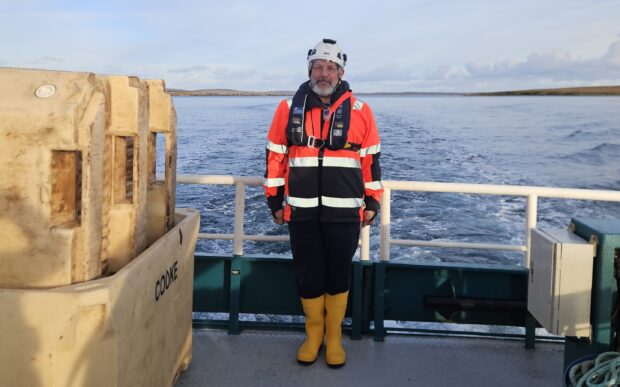
From interviewing witnesses on vessels to attending court for landmark prosecutions, no two days are the same for Paul Atkins, Financial Investigations Manager with the Maritime and Coastguard Agencies, Regulatory Compliance Investigation Team (RCIT).
Paul joined the Maritime and Coastguard Agency (MCA) in 2018 after 30 years in the police force. Based at the Cardiff Marine Office, he and his RCIT colleagues investigate significant maritime safety and compliance breaches. These can range from following up on recommendations from the Survey and Inspection (S&I) team, to call outs to investigate an incident. Investigations can be completed in just a few weeks, or last for years, depending on the nature of the incident.
Paul commented: “My role is totally varied, no day is ever the same. I could be in the office, travelling to the coast, out on a vessel or visiting someone inland. You have to have an open mind, and as a team we’re really supportive of each other.”
RCIT works on a 24/7 duty system, ready to deploy where necessary. Incidents generally occur in peaks and troughs throughout the year, with the peak tending to be during the school holidays, often due to the higher use of private vessels.
Piecing together an accurate picture of an incident relies on having strong relationships within and outside of the MCA and access to accurate data on the affected vessel, its owners and who was on board.
When Paul is working on a case, he looks at everything from conditions of vessels, qualifications of everyone in the crew, consequences of the incidents and how and why they happened.
The "golden hour" response
Responding quickly to incident reports is essential to capturing evidence whilst information is still fresh in the minds of those involved – dubbed “the golden hour response”.
Paul said: “In order to get to the bottom of what’s happened, we often need to interview multiple people to understand what went wrong. Due to the nature of the maritime industry, crew members can move between vessels. There are also many UK-based seafarers who are foreign nationals. This can make it difficult to get in touch with them if they move to another vessel outside of the UK.”
Paul recently attended court to hear the outcome of a case he’s been involved in since August 2024, when a man crashed his speedboat into a 15-year-old kayaker near Milford Haven. The man was sentenced to 12 months in jail, suspended for two years.
Paul said: “This prosecution, the first under new watercraft safety laws, sends a clear signal that people flouting the requirements that keep us all safe on the water are liable to be held accountable for their actions.”
Educate rather than prosecute
While some incidents end in legal proceedings, Paul would rather educate than prosecute, where possible.
“I had a case recently where a ship had run aground. I travelled to the site and spoke with the crew and the vessel’s owners. During his interview, the Officer of the Watch (OOW) admitted he'd fallen asleep.
“The owners didn’t want to prosecute so the OOW was given a caution. Amongst other recommendations, we asked them to review whether rest-time was satisfactory for the role. We’ll keep the details of what happened on our case management system so that if the OOW or vessel ever has an issue in the future, we can refer back to the circumstances of this incident.”
Having joined the MCA from a non-maritime background, Paul has learnt a lot from his RCIT colleagues and through collaborating with other departments. He’s also spent significant time in coastal communities, working with fishers and seafarers to understand their industries.
Transferrable skills
Paul commented: “I wanted to join the MCA because I was interested in the maritime industry and because I felt my criminal investigation skills would be an asset to the agency. It’s been exciting to meet people from around the world and establish a trusted relationship with them. I’m learning as much from them as they’re learning from me.”
Paul’s also been able to bring a specific skill from his policing career to the MCA. He continued: “I supported the introduction of Proceeds of Crime Act powers within the MCA on behalf of the Department for Transport, helping to broaden the MCA’s overall regulatory and investigative framework. This capability was approved in 2022 and now sits alongside existing tools to support proportionate and effective regulatory activity.”
Investigating cases can be very difficult, particularly when the incident has resulted in someone dying.
“A few years ago, I met the family of a man from Indonesia who’d died in a fishing accident in the UK. It was very humbling to see not just the emotional devastation of his loss but the financial impact it had on them.
“Seeing the real-life consequences of when things go wrong really gives you the determination to keep going, not listen to excuses, dig deeper, and push for changes to working conditions, because people don’t always feel able to speak up.”