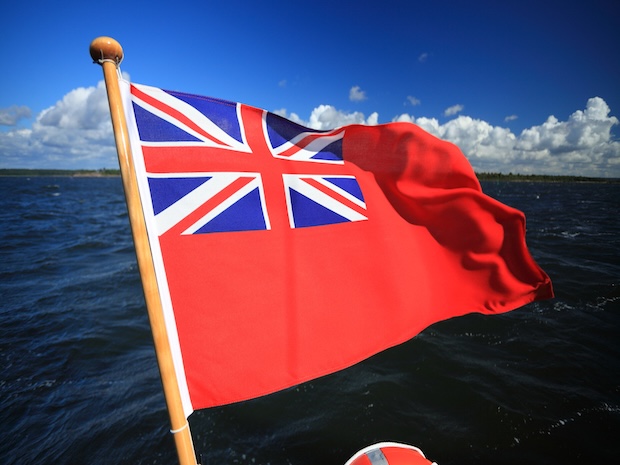
To mark Merchant Navy Day on Thursday 3 September, we're shining a light on the seafarers who keep the UK supplied with the goods we rely on every day, and hearing from someone who spent nearly two decades living that life.
One of those seafarers is Shajan Lukose, Head of Nautical Examiners at the Maritime and Coastguard Agency (MCA). He spent 18 years at sea, rising to captain his own ship in 2000. He started his career in 1989 when voyages were longer and shore leave, unusual by today's standards, could stretch to three or four days. Shajan said:
"Today, because of containerisation, shore leave can be a luxury. It’s still a way to see the world and for most sailing the high seas is thrilling in itself "
For much of his career, Shajan was able to have his wife accompany him on voyages.
"It is possible for certain members of crew to have family stay on board with them and I was fortunate enough for this to be the case for me. Allocations are based on rank and are dependent on the numbers on the lifeboats for safety reasons."
Life on board in the 1990s meant no internet, no streaming content, and letters that sometimes waited at port for weeks. While times could be challenging, Shajan recalls the camaraderie this created:
"It became a congregation of people who would sit and watch a film or come together to share stories and was a nice environment. Today's constant connectivity brings different worries; now that seafarers can keep in touch with family regularly it means they’re more exposed to concerns at home."
Command brought real responsibility. In the early 2000s, Shajan captained a large crude oil carrier, taking oil from the Persian Gulf to Japan and the United States. He said:
"A single hull tanker, fully loaded, is like a seven-storey building below the water. Navigating the shallow waters of the Malacca Strait left no room for error, any slight touch on a rock and it would rip open."
While being the captain of a large vessel naturally comes with huge pressure, Shajan explained that all seafarers realise the responsibility they carry to look after their cargo, themselves and their crew.
Today around 90% of the UK’s traded goods are transported by sea. Shajan said:
"It's all made somewhere else, containerised and brought here safely, then unpacked straight onto the shelf. Cargo ships move fast too; the journey from Shanghai to Felixstowe takes around 20 to 25 days which just shows how quickly things reach the market."
Shajan explained that the discipline he learned at sea has never really left him. It's a mindset he still brings to his work at the MCA where he trains and examines the next generation of seafarers.
Merchant Navy Day 2026
This Merchant Navy Day, we recognise seafarers like Shajan, whose work, often unseen, plays a crucial role in keeping the UK supplied with goods.
Seafarers and organisations across the UK are encouraged to mark Merchant Navy Day 2026 by flying the Red Ensign and recognising the vital contribution of merchant seafarers.
President of the Seafarers’ Charity, His Royal Highness Prince Edward, the Duke of Edinburgh, said:
“It’s that time of year when I seek your support in marking Merchant Navy Day on Thursday 3 September by flying the Red Ensign. This year more than ever, our dependence on our nation's Merchant Navy has been highlighted by the events in the Arabian Gulf and especially the Strait of Hormuz.
“Whether flying the flag or spreading the word about their tireless work transporting our island nation’s trade, this is an excellent opportunity to show our seafarers and their families how much we all value them.
“On behalf of The Seafarers’ Charity, thank you in advance for your support.”