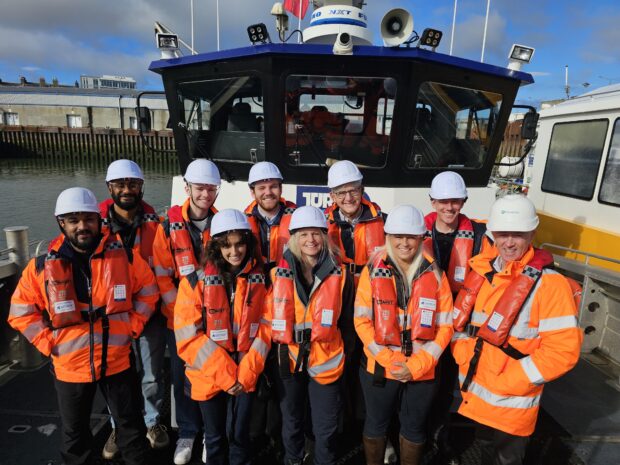
Colleagues from the Maritime and Coastguard Agency (MCA) visited Kincardine Floating Offshore Windfarm to gather practical insight for new guidance on the towage of floating offshore foundations and turbines.
The team visited Kincardine Floating Offshore Windfarm this August, gaining first-hand insight into the design and operation of semi-submersible platforms. This technical knowledge will feed into a new Marine Guidance Note (MGN) due to be published later this year.
This guidance brings together the existing towage requirements for floating offshore structures, including wind turbine foundations, tidal and wave energy devices, and aquaculture barges. Having this information in one place will give those in the sector a quick point of reference, supporting safer towage practices for large maritime structures.
The trip was organised by offshore wind developer Flotation Energy, and attended by Vinu John, Navigation Licensing Lead, and Immanuel Josy, Navigational Advisor, both from the Marine Safety and PNT Services team. They were joined by Lisa Tuckwell, acting Secretary of State's Representative for Maritime Salvage and Intervention (SOSREP).
Immanuel said:
"We were delighted to visit Kincardine and see a floating offshore wind farm operating first-hand. The boat tour gave us a valuable opportunity to understand how the site works in practice, speak directly with industry experts, and ask questions relevant to the Maritime and Coastguard Agency's (MCA's) new MGN.
"It was particularly useful to meet members of Flotation Energy’s Green Volt project and learn more about one of the UK's next major floating offshore wind developments, providing valuable insight into the future direction of the sector."
The future of floating offshore wind
Following the site visit, the team attended a series of presentations at ORE Catapult, where researchers provided updates on ongoing work relating to dynamic subsea cables, mooring and anchoring systems, and fishing and ecological assessments. This research is helping to tackle some of the technical and environmental challenges that come with floating offshore wind farms.
Kincardine has been operating since 2021 and while it is an impressive large-scale farm, it represents a fraction of the scale of future developments. Turbines currently being planned for Scottish waters and the Celtic Sea are expected to be around three times the size, highlighting the rapid pace of innovation within the floating offshore wind sector.
About Kincardine
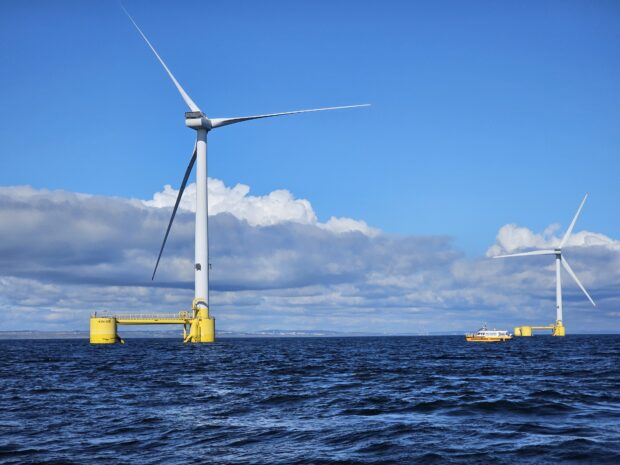
Kincardine is currently the largest grid-connected floating wind farm in the world. It has five turbines, each capable of generating 9.5 megawatts (MW), giving it a total capacity of almost 50 MW. That's enough to power around 55,000 homes in Scotland.
The turbines sit in water depths of 60 to 80 metres and are held in place by three mooring lines connected to their floating foundations. Each foundation also has an active ballast system, which adjusts the turbine's position in the water depending on weather and sea conditions, keeping it stable in stormy weather.
Supporting future search and rescue planning
The visit provided valuable insight into the operational realities of floating offshore wind farms and offered a deeper understanding of upcoming projects such as Green Volt. The knowledge gained is also contributing to a series of industry workshops on the emergency response aspects of Floating Offshore Wind, organised by HM Coastguard's Offshore Energy Liaison team in collaboration with SOSREP.
Lisa said:
"As offshore renewable energy continues to expand around the UK it is important that we understand and prepare for the unique challenges it presents. Ensuring effective arrangements for search and rescue, pollution response, towage and salvage will be critical to supporting the sector's safe and sustainable development."