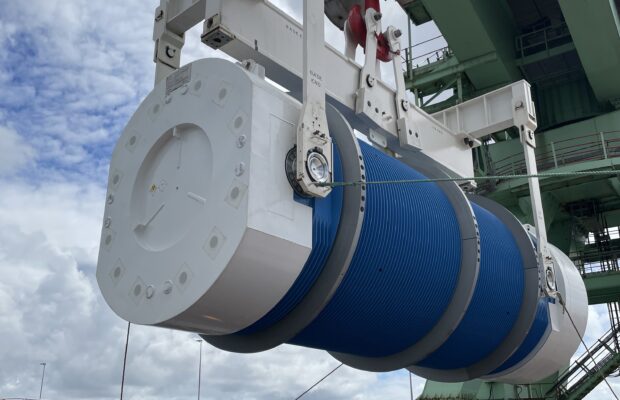
To mark National Dangerous Goods Awareness Day, which falls during Maritime Safety Week, we're shining a light on the Maritime and Coastguard Agency team working every day to ensure the safe and legal carriage of cargo, including dangerous goods, to and from the UK.
With over 90% of UK imports and exports transported by sea, the work of the Maritime and Coastguard Agency’s (MCA) Cargoes, Safety and Pollution Prevention (CSPP) team touches almost every aspect of our daily lives.
Led by Alison Kentuck, the team is responsible for assessing the safety and environmental requirements of cargoes, setting and implementing the legal standards for their carriage by sea, and taking part in compliance inspections.
Alison said:
“With an incredibly diverse range of cargoes moving in and out of the UK daily - everything from nuclear material and the ‘snaps’ in Christmas crackers, to coat hangers, clinical waste and renewable energy sources - we work with stakeholders across the industry to align safety, environmental protection and the efficient flow of global trade.
"It isn’t always easy, but it means that every day brings a new challenge.”
Working alongside Alison are Cargoes Lead Peter Boden, a Hazardous Cargoes Lead and Cargoes Advisor Ian Platts.
The team’s work is very varied and could include:
- assessing new bulk liquid chemicals and setting the safety and pollution prevention requirements for their transport by sea
- working with the MCA’s Counter Pollution team to help keep our seas clean or advise on cargo hazards during an incident
- advising on complex dangerous goods transport issues
- implementing measures to prevent containers being lost overboard
- negotiating new international safety and marine pollution prevention laws
In an ever-changing global landscape, some of the challenges the team face include ensuring the safe carriage of electric vehicles, establishing new mandatory requirements for plastic pellets to prevent plastics pollution in the marine environment and working internationally and in the UK to develop standards for the bulk transport of emerging alternative fuels.
The CSPP team also represents the UK in the International Maritime Organization (IMO) for all matters related to the carriage of cargoes.
Alison explained:
“Representing the UK at the IMO is perhaps one of the most impactful parts of our job. Having a direct role in shaping international standards that keep ships and seafarers safe and protect the marine environment is a privilege and a responsibility.”
The CSPP team are actively involved in the development of international standards for the carriage of cargoes in general, and current work includes setting standards for the carriage of liquefied gas alternative fuels such as hydrogen and ammonia. There is also ongoing work as part of the IMO’s Editorial and Technical Group, which develops updates and amendments to the International Maritime Dangerous Goods (IMDG) Code. They are also on the Evaluation of Safety and Pollution Hazards of Chemicals (ESPH) technical group, on which the UK is a leading member.
Closer to home, the team work with partners across the country to ensure cargo safety and pollution prevention, including HM Coastguard and MCA surveyors, as well as the police, other government regulators and industry groups.
For the transport of dangerous goods, the IMDG Code is part of a globally harmonised and multimodal regulatory framework. This means that, as far as is possible, a dangerous goods cargo can leave the UK on a journey that might include transport by road, sea and rail and span multiple countries, but regulations are the same, which enables a seamless journey and a consistent level of safety.
When breaches of the regulations are found, some may be serious and others may be more readily rectified.
Alison continued:
“Dangerous goods cargo inspections can be carried out jointly with other government regulators or alongside MCA marine surveyors. As the regulations are specific to the hazards of the cargo and very detailed, a container might fail an inspection for something as simple as the condition of the placards on the outside of the container that tell you what dangerous goods it carries.
"These placards should be attached securely so that, if the container were to fall overboard, the placards would survive for at least three months underwater. If that placard is peeling or coming away, the likelihood is that the container won’t be going anywhere until the placards are replaced.”
While most of the team’s work is based in the UK, they do occasionally travel and were recently invited by the French authorities to witness an inspection in Calais of hazardous cargo that was destined for the UK. This type of multinational inspection helps strengthen international collaboration and harmonisation around cargo safety and pollution prevention and recognises the global nature of UK trade.
The UK relies on the efficient movement of goods, but cargoes don’t always fit neatly into regulatory requirements. When faced with a cargo that might be unusual, complex or sensitive, the CSPP team must work to find safe, practical and effective solutions.
Alison gave an example:
“The UK manufactures specialist tech for the space industry, but this complex and sensitive technology has specific transport needs that involve careful planning. Finding solutions with equivalent safety levels means we can help UK industries to grow whilst ensuring ship safety and preventing pollution of the marine environment.”
Reflecting on National Dangerous Goods Awareness Day, Alison finished:
“If you are involved in the dangerous goods transport chain, why not take this opportunity to brush up on your dangerous goods training, review your dangerous goods operating procedures and check you are using the most up to date edition of the IMDG Code and ADR.”